
PackCAD Mockup User Interface
PackCAD Mockup is an online tool that converts flat designs and dielines into realistic 3D packaging mockups. This guide walks through the app’s layout, menus, and key controls.
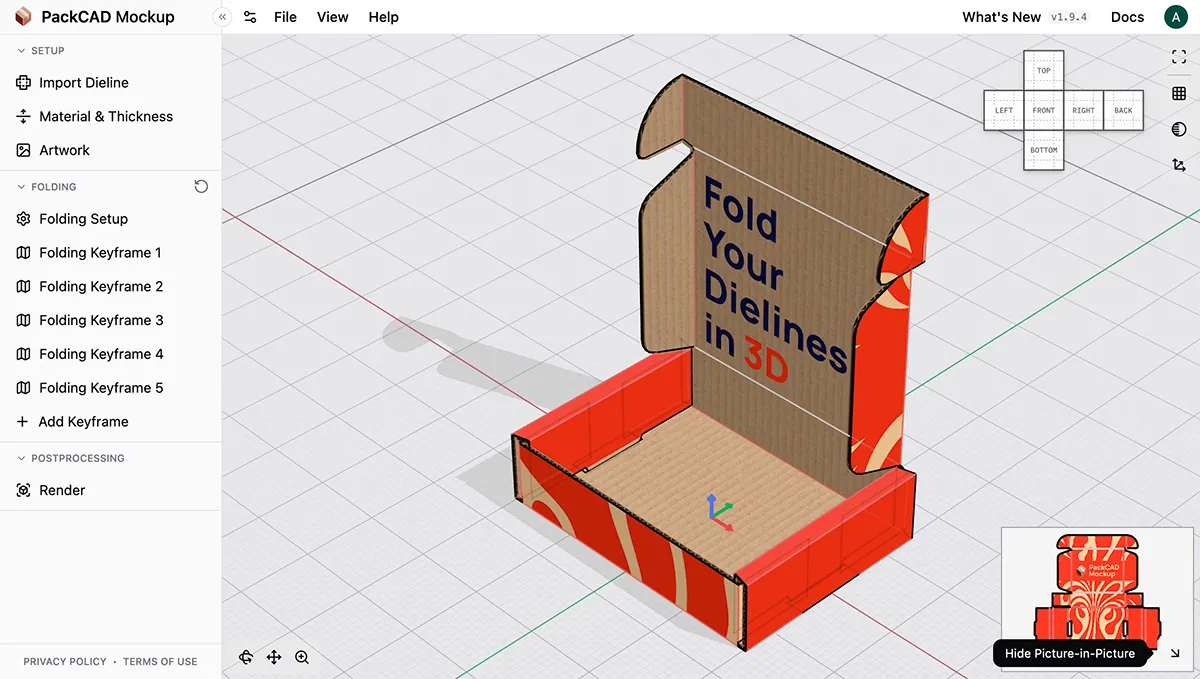
The Main Layout
The interface is organized into four main areas:
- Header - The top bar with Preferences, the File, View, and Help menus, and Account controls.
- Left Menu - A vertical list of operations that define your project, from importing a dieline through folding.
- 2D and 3D Views - The center of the screen, where you see your dieline and folded model.
- Detail Menus - When you select an operation in the left menu, its detail menu opens beside the left menu, with controls for that step.
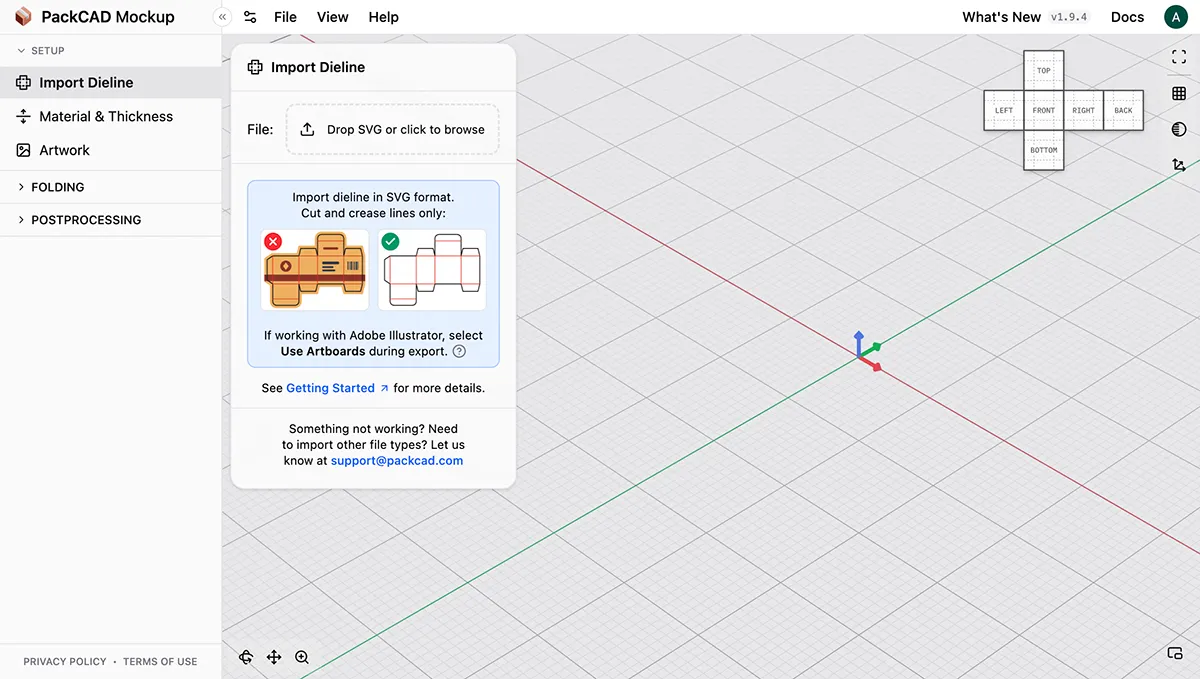
Drag a dieline (SVG), project file (JSON), or artwork image (PNG/JPG) into the app at any time. Drop zones appear over the 2D and 3D views showing what each drop will do.
Header
Preferences
Click in the header to open the Preferences menu. Preferences let you set defaults that persist across sessions. Settings changed elsewhere in the app (e.g., adjusting the view layout or thickness from a detail menu) are temporary and will reset on your next visit. To make a setting persistent, set it here.
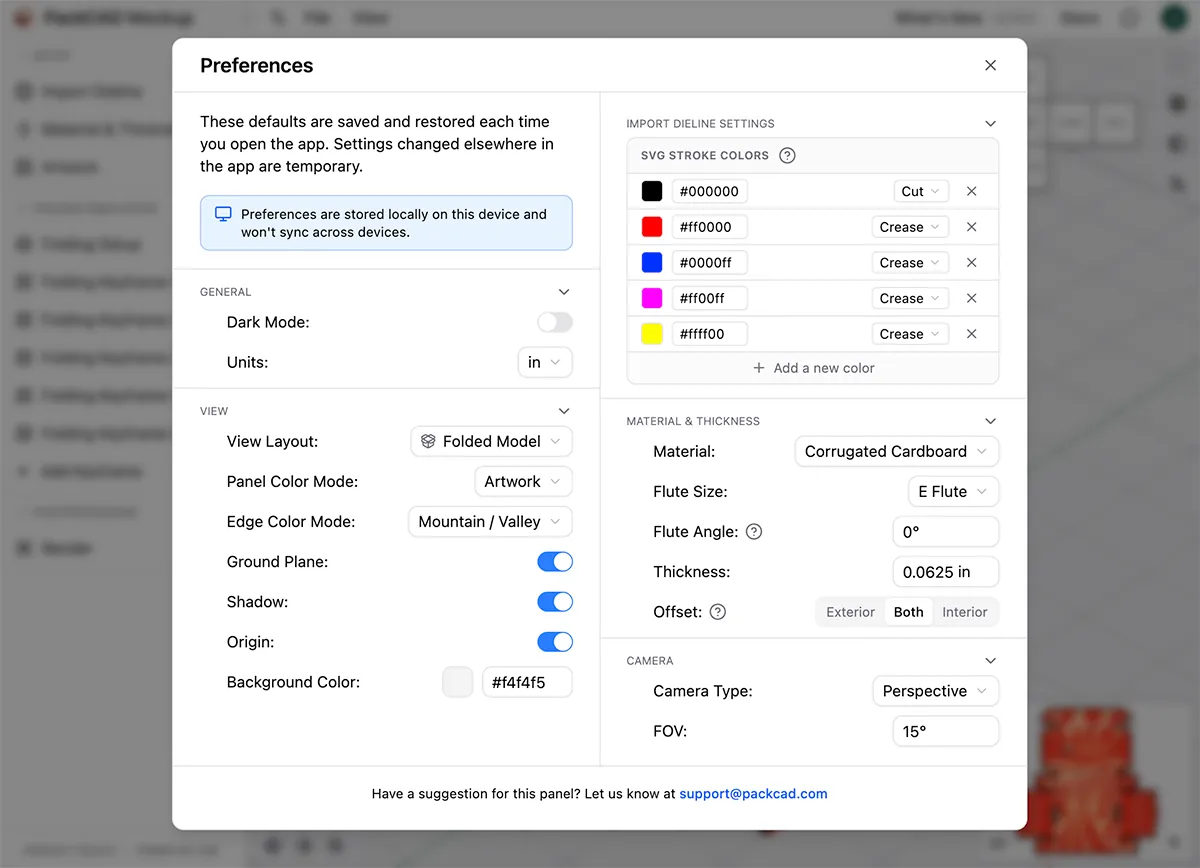
The Preferences menu is organized into five sections:
- General - Toggle Dark Mode and set the default Units (in, mm, or cm).
- View - Set defaults for View Layout, Panel Color Mode, and Edge Color Mode; toggle the visibility of Ground Plane Pro, Shadow Pro, and Origin Pro; and set the Background Color Pro.
- Import Dieline Settings - Set the SVG Stroke Colors that identify cuts and creases when you import a dieline (see Unused Stroke Colors).
- Material & Thickness - Set the default Material type, Flute Size and Flute Angle (for corrugated cardboard), Thickness, and thickness Offset (toward the exterior, toward the interior, or both).
- Camera - Set the default Camera Type (Perspective or Orthographic) and FOV (field of view, for perspective cameras).
Preferences are saved locally on your device and won’t sync across different devices or browsers. Each setting you’ve changed shows a reset button next to it, and when anything differs from its default, a Restore Defaults button appears at the top of the menu to reset everything at once.
File Menu
The File menu contains project and export actions:
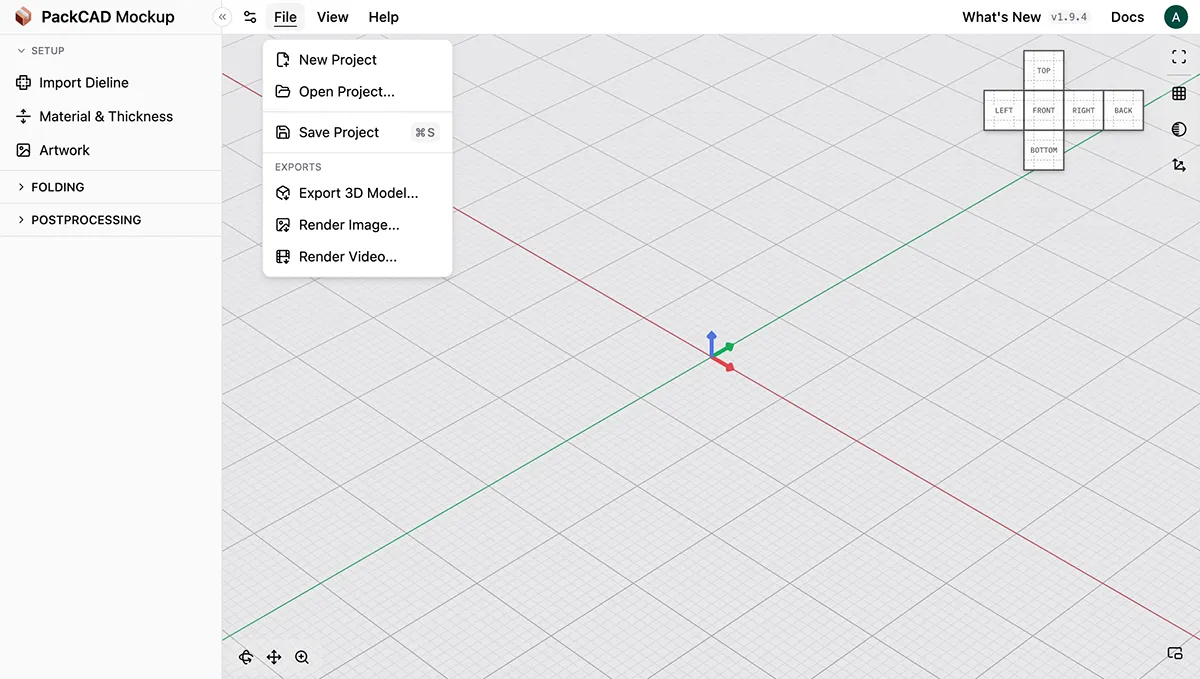
- New Project - Start a fresh project.
- Open Project... - Load a previously saved project file (JSON).
- Save Project (
Ctrl/Command + S) - Save your current project as a JSON file. - Export 3D Model... Pro - Export your folded design as a 3D file (glTF, GLB, OBJ, or HTML).
- Render Image... - Open the render tool to create a photorealistic rendering of your packaging. See the Photorealistic Rendering guide.
- Render Video... - Open the render tool on its Video tab to record a 360° turntable animation of your packaging.
View Menu
The View menu controls how your design is displayed:
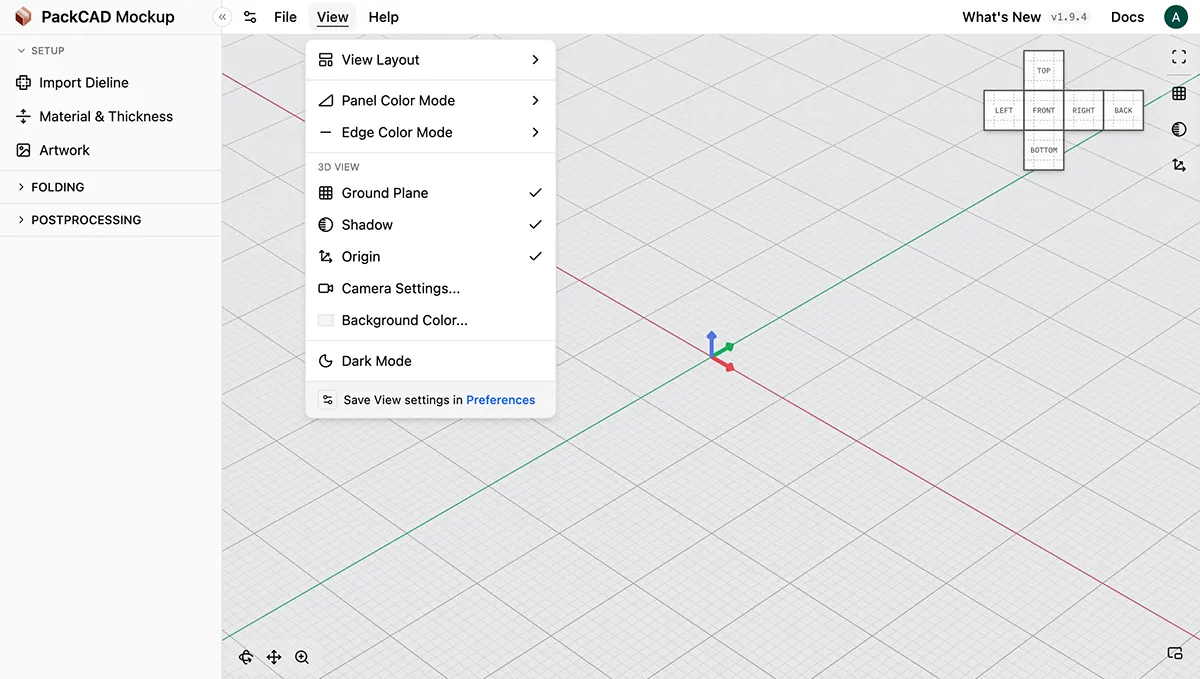
- View Layout - Switch between
Folded Model (3D focused), Dieline (2D focused), Split
Horizontally, and Split Vertically. You can also use the
2and3hotkeys for the dieline and folded model views. - Panel Color Mode - Choose how panels are colored: Artwork (shows your uploaded print graphics), White, or Multicolor (each panel a different color, useful for verifying your dieline was parsed correctly).
- Edge Color Mode - Choose how fold and cut lines are displayed: Mountain / Valley (creases are colored red or blue based on their fold direction and angle; cut lines are black), Black (cut lines are solid, crease lines are dashed), or Hidden (don’t render crease or cut lines).
- 3D View - Toggle the visibility of the Ground Plane Pro, Shadow Pro, and Origin Pro. Open Camera Settings..., or set a custom Background Color… Pro.
- Dark Mode - Toggle between light and dark themes.
Changes made in the View menu last for the current session. Click Save View settings in Preferences at the bottom of the menu to set them as your defaults.
Help Menu
The Help menu contains learning resources and ways to reach us:
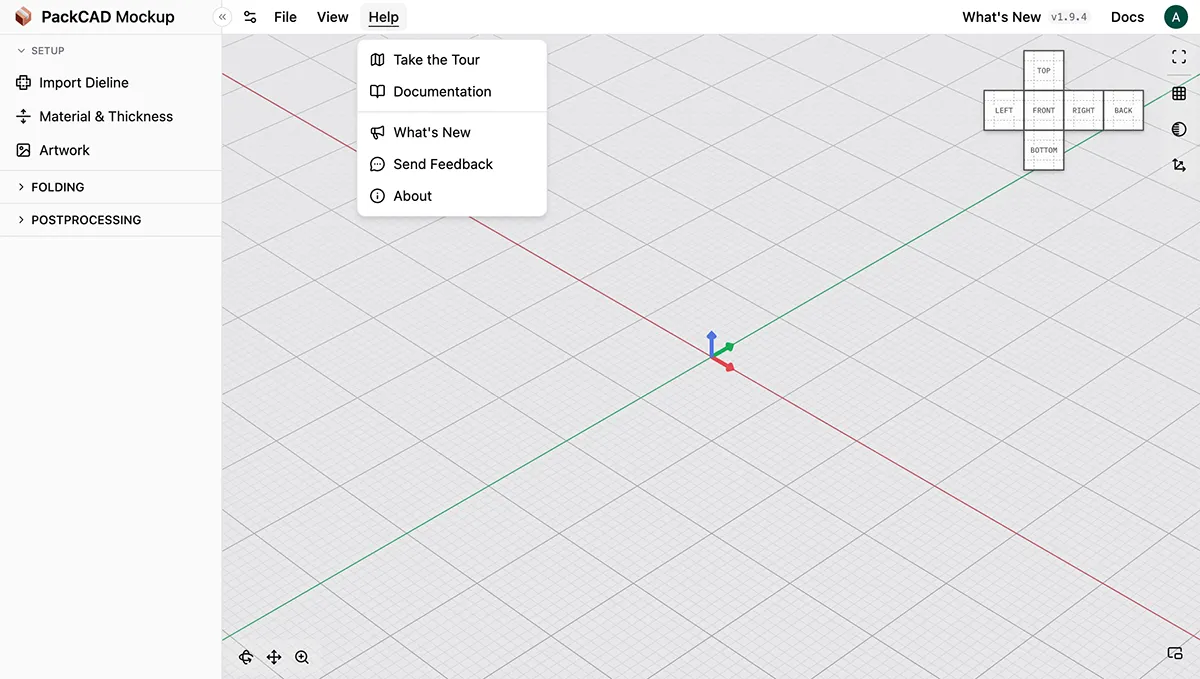
- Take the Tour - Start a short interactive tour that folds the example mailer box, adds a foil finish, and renders a product shot. The tour is available on larger screens only.
- Documentation - Opens the documentation site.
- What's New - View the changelog.
- Send Feedback - Send feedback or report an issue.
- About - Version and licensing information.
Other Header Controls
On the right side of the header, you’ll find:
- What’s New - View the changelog. The current version number is shown beside it, and a green dot appears when there are unread updates.
- Docs - Opens the documentation site.
- Account - Sign in, view your subscription, or manage your account.
Left Menu
The left menu lists the operations that make up your project. Operations are applied in order from top to bottom, and each one transforms your design in some way. They’re organized into three collapsible sections — Setup, Folding, and Postprocessing. Click a section heading to collapse or expand it. The Folding and Postprocessing sections start collapsed and open automatically once you import a dieline.
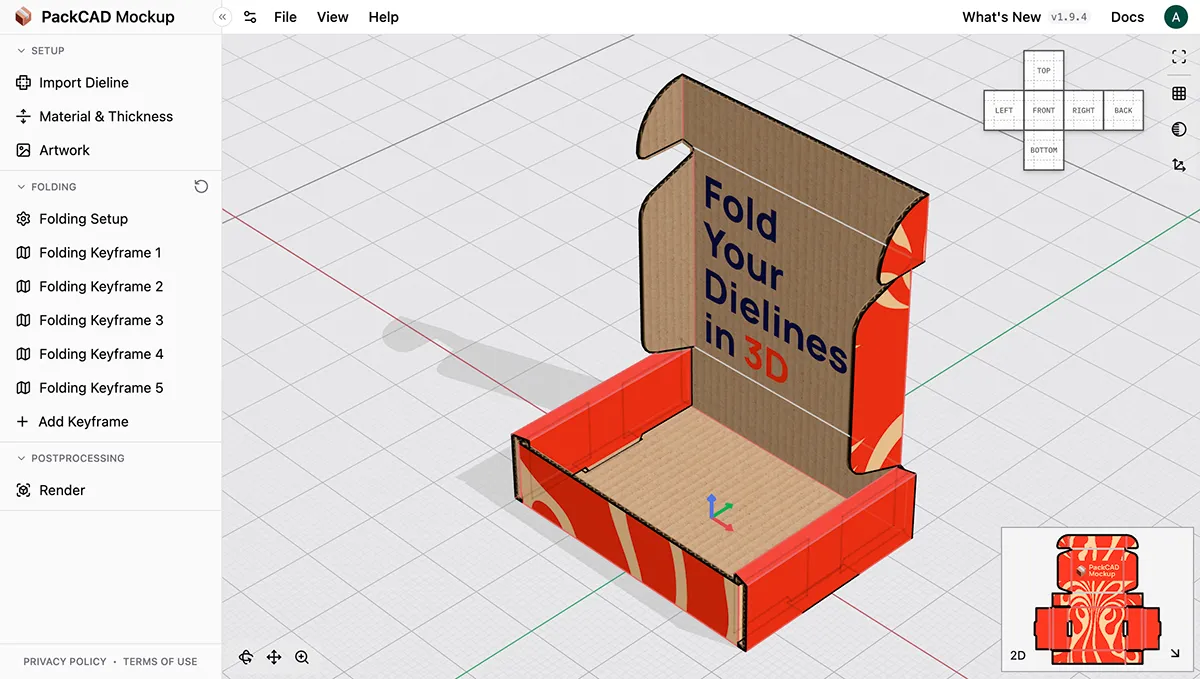
The Setup section defines your physical package:
- Import Dieline - Upload your dieline SVG file.
- Material & Thickness - Choose a material type and thickness.
- Artwork - Add exterior and interior artwork layers (PNG/JPG), plus finishes like spot color, foil, emboss, and coatings.
The Folding section folds it into 3D shape:
- Folding Setup - Select the bottom panel and (optional) origin point.
- Folding Keyframes - Define fold angles and
build a folding animation. You can add multiple keyframes using
Add Keyframe at the bottom. Click
in the section heading to replay the folding
sequence (
Rhotkey).
The Postprocessing section turns your folded mockup into final imagery:
- Render - Open the Render tool to create photorealistic renderings and 360° turntable videos of your packaging. Completed images appear as a small thumbnail stack on this item. See the Photorealistic Rendering guide.
Click any operation to select it and open its detail menu (the Render tool opens as a full-screen view instead). See Getting Started for a full walkthrough of these steps.
The left menu is collapsible. Click on the
menu’s right edge to collapse it, and to
expand it again (Ctrl/Command + B).
Enable / Disable
The Artwork operation and individual Folding Keyframes can be toggled on and off. Hover to reveal the visibility toggle , then click it to disable the operation and temporarily remove its effect from the design without deleting it. A disabled operation shows ; click again to re-enable. You can also choose Disable or Enable from the menu at the top of the operation’s detail menu.
Reordering Keyframes
Folding keyframes can be reordered by grabbing the grip and dragging them to a new position. Keyframes are applied sequentially, so their order determines the folding animation sequence.
Detail Menus
When you select an operation in the left menu, its detail menu opens beside it, floating over the 2D or 3D view. Each detail menu contains the settings and controls specific to that operation.
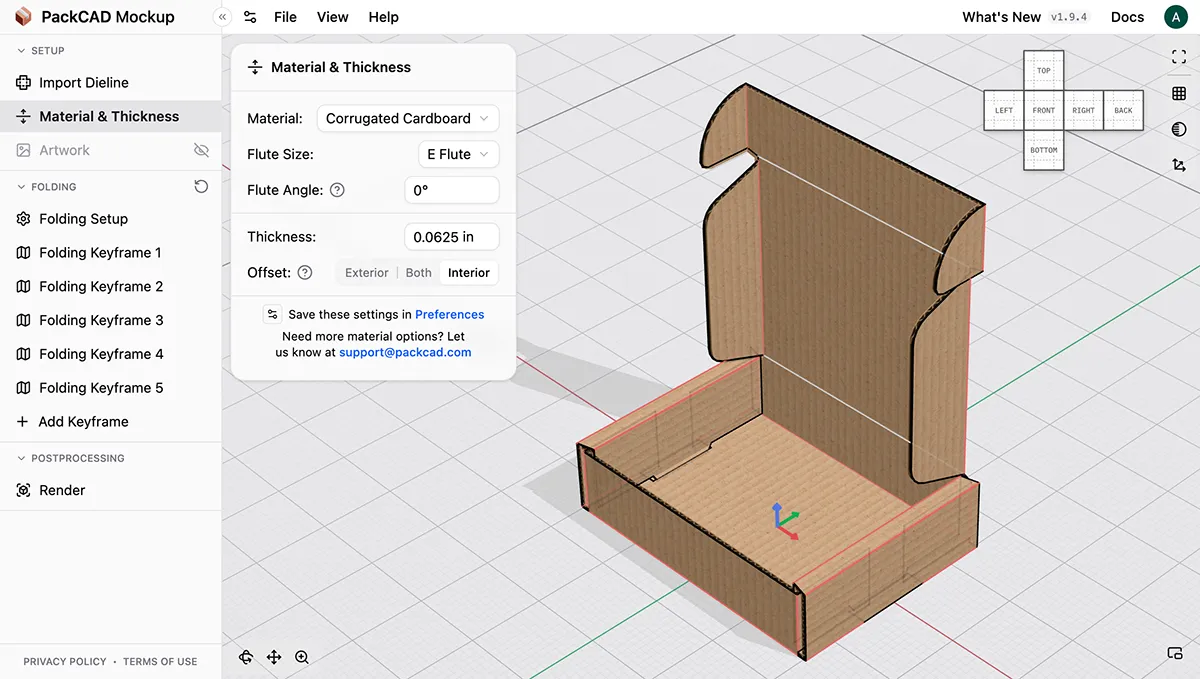
For example:
- The Import Dieline detail menu shows the uploaded file, dimensions, and unit settings. Click Dieline Inspector... to review how your cut and crease lines were parsed.
- The Material & Thickness detail menu lets you choose a material type, set a thickness value, and control the thickness Offset.
- The Artwork detail menu lists your Exterior layers and Interior layers. Click to add a layer, click a layer to edit its Layer properties, or open its menu to disable, duplicate, mirror, download, or delete it. Use Swap exterior and interior to swap the two sides. See Print Finishes and Effects for a guide to each layer type.
- The Folding Setup detail menu is where you select the bottom panel. Expand Advanced Options to also set an optional origin point.
- The Folding Keyframe detail menu contains simulation controls and fold angle constraints. Its menu lets you Disable, Duplicate, or Delete the keyframe. See 3D Packaging Folding Animation for a detailed guide.
Select any number input and scroll to nudge the value up or down. Many
inputs, including fold angles, also have a slider: hold Shift while
dragging it to snap to larger steps.
Alerts
If an operation has errors or warnings, an alert badge appears on the operation in the left menu and on the upper-left corner of its detail menu. Click the badge to see the error/warning messages.
2D and 3D Views
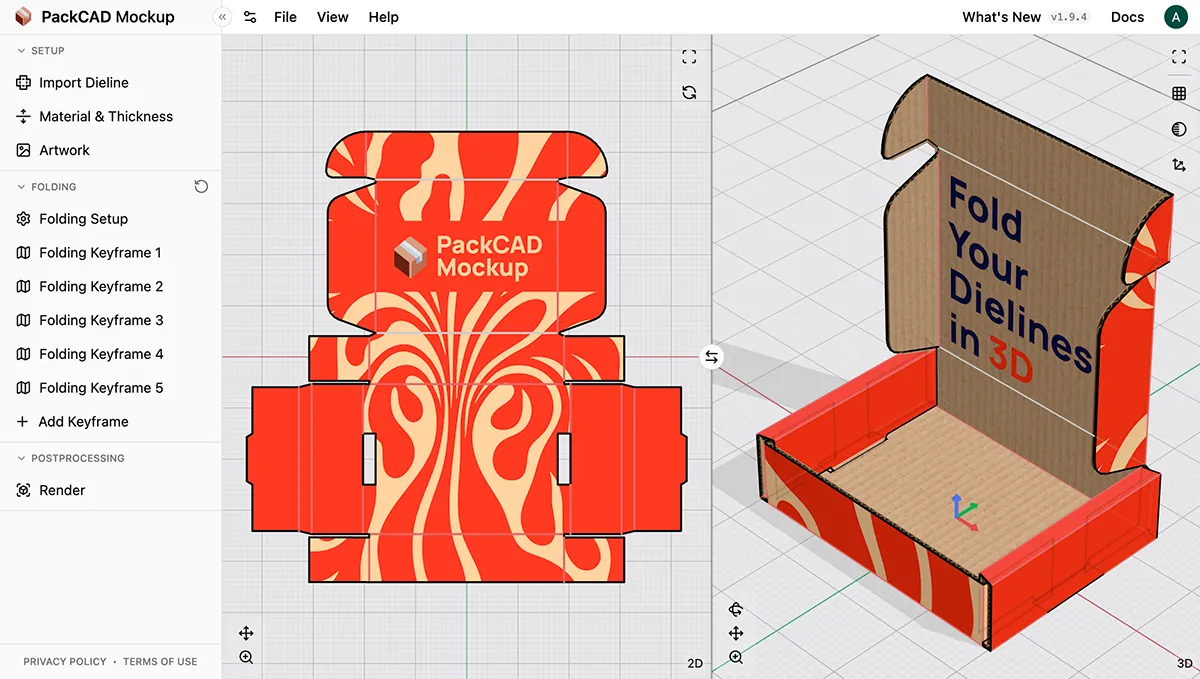
The center of the screen shows your design in 2D (the flat dieline) and 3D (the folded model). There are four view layouts, controlled from the View menu or keyboard shortcuts:
- Folded Model (
3hotkey) — 3D view fills the screen, with a small 2D picture-in-picture in the corner. - Dieline (
2hotkey) — 2D view fills the screen, with a small 3D picture-in-picture in the corner. - Split Horizontally - 2D and 3D views side by side.
- Split Vertically - 2D and 3D views stacked one above the other.
Split Views
In the split layouts, drag the divider between the 2D and 3D views to resize them, or double-click it to return to an even split. Hover over the divider and click to swap which side each view is on. A small 2D or 3D label in the corner of each view tells them apart.
Picture-in-Picture
In the Folded Model and Dieline layouts, the smaller view appears as a picture-in-picture window in the bottom-right corner. Click it to quickly swap which view is focused (or use the 3 and 2 hotkeys). Click in its corner to hide the picture-in-picture window, and to bring it back.
Often, it is easier to select creases from the 2D view when editing a Folding Keyframe.
3D View Controls
A small toolbar appears in the top-right of the 3D view containing the following controls:
- Center 3D View - Reset the center/zoom of the camera to fit your model.
- Ground Plane Pro - Toggle the ground plane grid visibility (z = 0).
- Shadow Pro - Toggle the shadow visibility beneath your model.
- Origin Pro - Toggle the origin indicator visibility (x = 0, y = 0, z = 0).
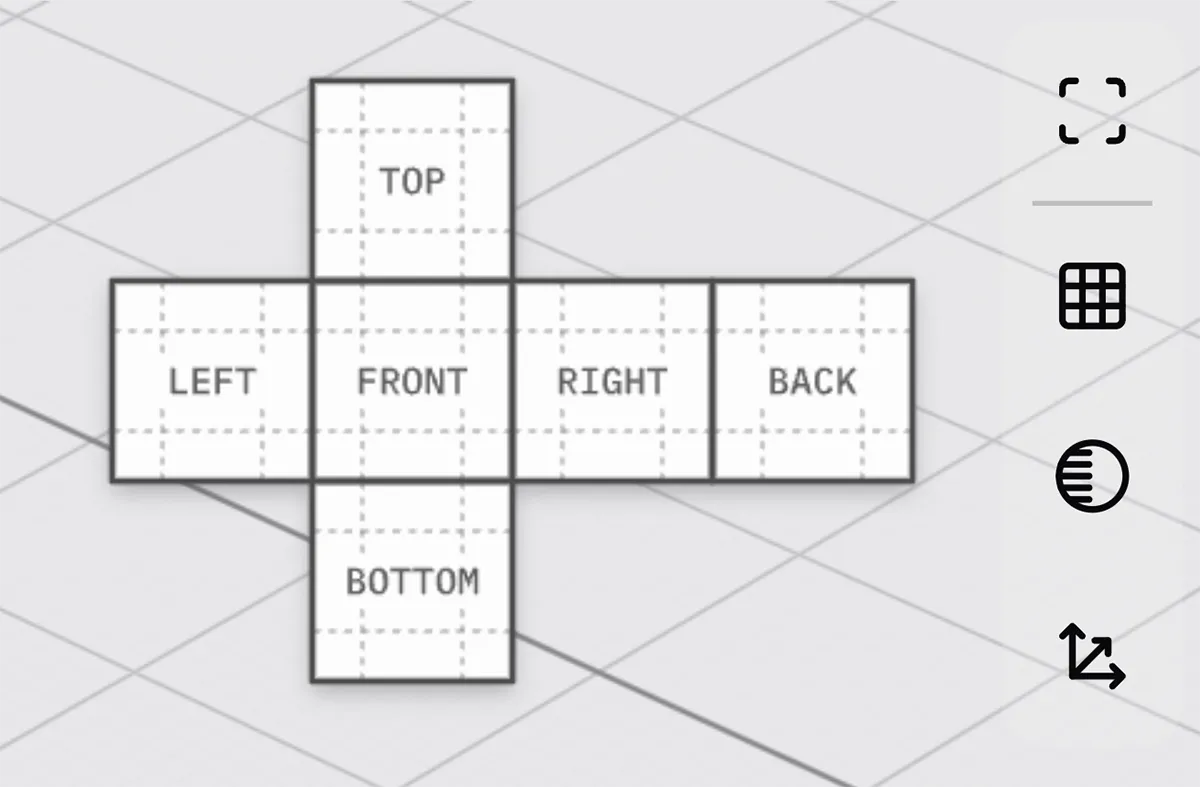
Navigation control: Beside the toolbar, an unfolded-box diagram allows you to control the orientation of your model in the 3D view. Click one of the cube’s faces, edges, or corners to snap the 3D model to a front, top, side, or corner view; the name of the view appears below it.
Camera interaction: Click and drag to orbit, scroll to zoom, and right-click and drag (or Ctrl/Command + drag, or two-finger drag) to pan.
Hover over the icons in the bottom-left corner of the view ( ) for a reminder of these gestures.
2D View Controls
A small toolbar appears in the top-right of the 2D view containing the following controls:
- Center 2D View - Reset the center/zoom of the camera to fit your dieline.
- View Interior Side / View Exterior Side - Flip the dieline over to see its other side.
Interaction: Right-click and drag (or Ctrl/Command + drag) to pan, and scroll to zoom toward your cursor.
Hover over the icons in the bottom-left corner of the view ( ) for a reminder of these gestures.
Keyboard Shortcuts
The following hotkeys are available throughout the app:
| Shortcut | Action |
|---|---|
2 | Switch to dieline view |
3 | Switch to folded model view |
R | Replay the current keyframe (or the full folding animation if no keyframe is selected) |
Ctrl/Command + A | Select all (during a crease or panel selection) |
Escape | Cancel the active selection, or deselect the current operation |
Ctrl/Command + S | Save project |
Ctrl/Command + B | Toggle the left menu |